What To Do If Someone Catches Fire:
Smother the flames by covering their body with a fire blanket, a rug, or any type of blanket
More oxygen makes fire GROW, so smothering the fire with a blanket decreases the amount of oxygen
NEVER try to fan the fire on a person or on the fire around them because adding airflow will increase oxygen
Never wrap a standing person. Make sure they lay down first.
Avoid using a fire extinguisher on the person because it can cause chemical irritation
NEVER apply ice directly on burns. Wet a towel with cold water and gently apply on the burned area.
In The Classroom:
NEVER pour flammable liquids from a container over or near an open flame.
If pouring flammable liquids, use the smallest beakers possible, and keep larger containers of flammable liquids out of the classroom.
Do not use Erlenmeyer flasks, Florence (boiling) flasks, or other glassware with a long, thin, or tapered neck to pour flammable liquids.
Keep students at a safe distance, or use barriers to separate students from the flame.
Always wear PPE (Personal Protective Equipment)
Always keep long hair tied up
Never keep the flame close to the ignition origin
The Dangers of METHANOL:
A HIGHLY flammable, colorless, watery liquid
A toxic alcohol that is typically used in classroom fire demonstrations
Chemical Dangers:
Methanol reacts violently with strong oxidants, causing a fire and explosion hazard.
Methanol has INVISIBLE FLAMES, which refers to a trail of vapor that lasts after a fire has gone out and can instantly ignite anything
Mixtures of methanol vapor and air are explosive.
If You Catch On Fire...
The most important thing for you to do is:
STOP - where you are
DROP - to the floor
ROLL - around on the floorIt seems like a simple thing we learn from elementary school, but in the moment, you may be panicking and forget to do so. Always remember STOP, DROP, and ROLL, because it could save your life.
Never Fight A Fire If:
If the fire is spreading beyond the spot where it started.
If you can't fight the fire with your back to an escape exit.
If the fire can block your only escape.
If you don't have adequate fire-fighting equipment.
Using A Fire Extinguisher:
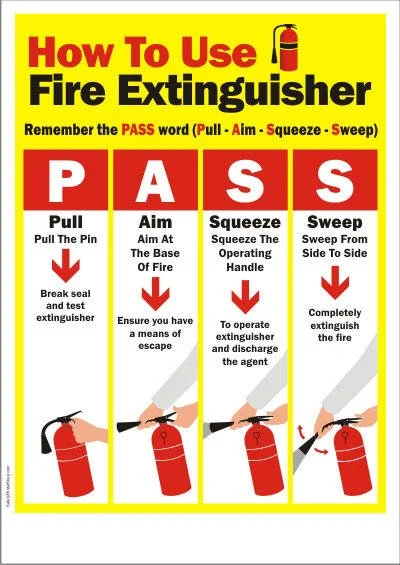
Only use a fire extinguisher for small, contained fires
Aim directly at the BASE of the fire, not the flame itself
Flame Jetting:
Happens when a container of flammable liquid meets an ignition source, causing flames to shoot out 15 feet, or even more.
Happens most commonly in high school classroom science demonstrations
Almost any necked, portable, flammable liquid container with a flammable liquid can potentially jet.
Common flammable liquids include gasoline, methanol, ethanol, acetone, and liquor above 150 proof. Containers with large openings, such as buckets, cannot jet.
Typically, the container is tilted and vapors are pouring from its mouth. This allows air to enter the container's headspace.
If the container has a nozzle installed when combustion occurs, flames can travel back into the container.
If no nozzle is installed, typically the person pouring the container is uninjured and injuries will occur to victims located opposite the container.
The longest flame jets occur when a container is about one-third full of liquid.
In cases involving gasoline jetting, older (weathered) gasoline that has undergone evaporation is more prone to jetting because older gasoline releases vapors more slowly than fresh gasoline.
Flame arrestors are highly effective in preventing flame jetting. They typically cost about 50 cents.
Sources:
https://ocfire.com/index.php/fire-safety/what-do-if-trapped-burning-building
https://www.cpsc.gov/s3fs-public/Chemistry-Experiments-Checklist-website.pdf
https://www.cdc.gov/niosh/ershdb/emergencyresponsecard_29750029.html
https://institute.acs.org/acs-center/lab-safety/incidents-and-accidents/flame-jetting.html